PhD Research Programme
iBIM-LAP: intelligent BIM Look-ahead Planning
Integrating BIM and Multiple Construction Monitoring Technologies for Acquisition of Project Status: Information Requirements, Rules, Tools & Technologies
As one of the early Digital Twin-oriented approaches for construction operations, iBIM-LAP integrates real-time monitoring technologies to provide actionable insights into project performance, including time, cost, progress, and quality. The system enables project teams to visualize and analyse construction activities as they occur, track who performed specific tasks, for how long, with which resources, and at what quality level. By connecting real-time construction data with BIM environments, the framework supports automated progress tracking, enhanced visualisation, and predictive analysis—helping project teams improve productivity, reduce delays, and maintain better alignment with project objectives.
PhD Thesis Work (Completed in 2023) — Dr. Saed Hasan, supervised by Prof. Rafael Sacks at the Technion — Israel Institute of Technology.
Download Full Thesis (PDF)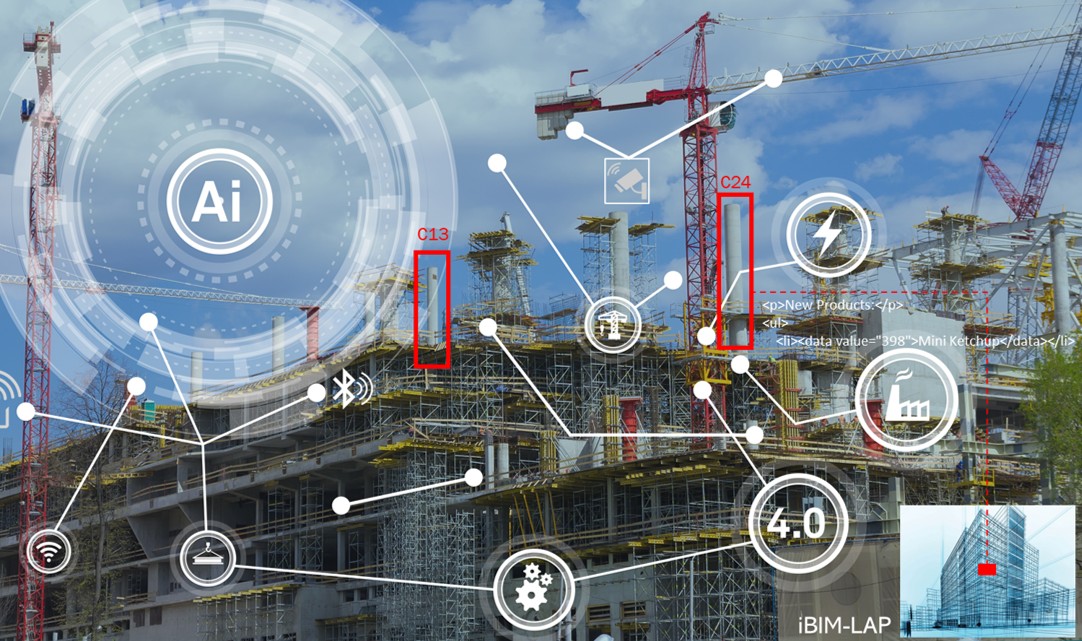
iBIM-LAP Information Flow

Event Processing Model [EPM]: What work was done → when → by whom → for how long → and with what quality?
iBIM-LAP: System Map
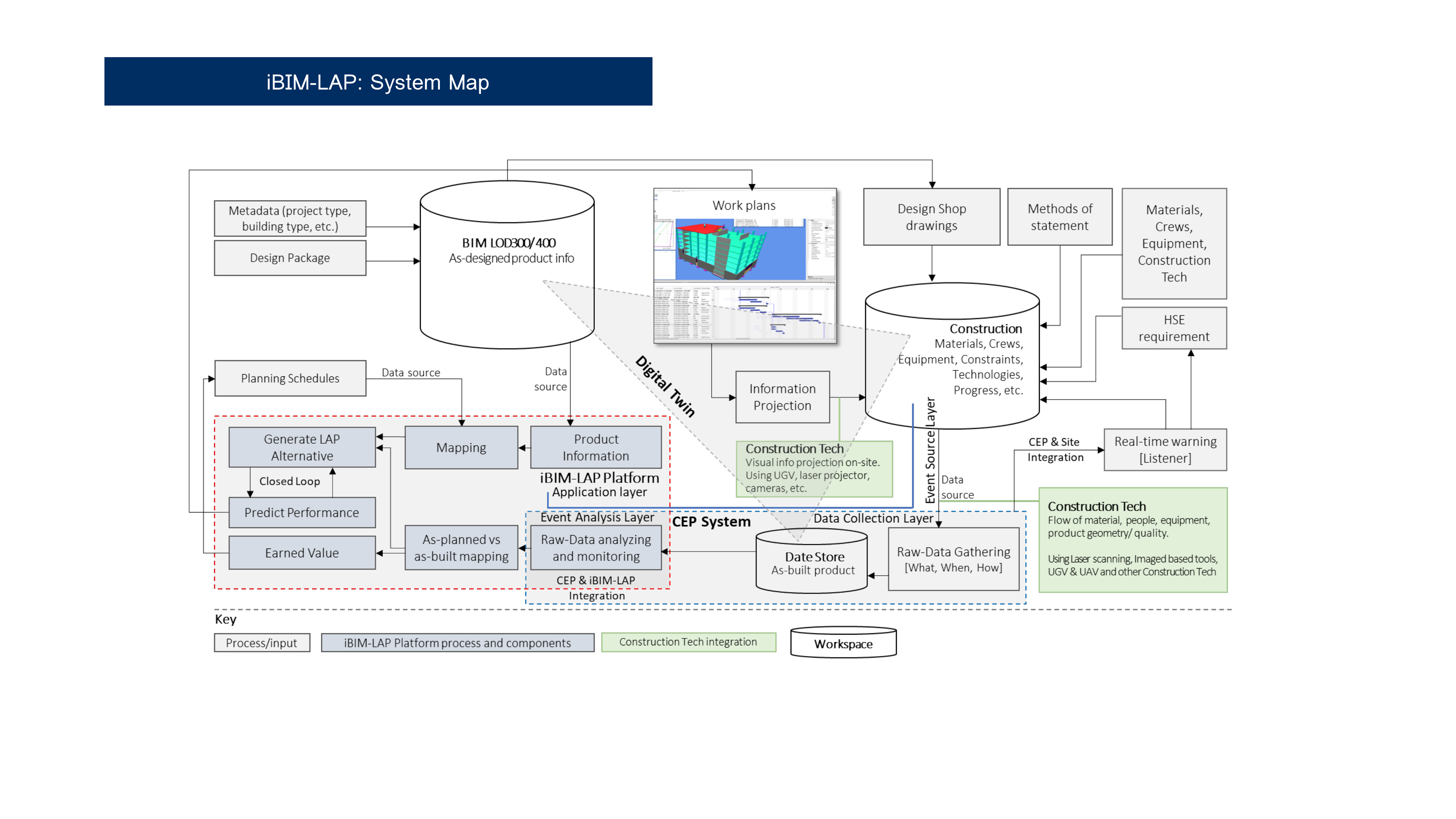
System architecture integrating BIM, Digital Twin, CEP System, and Construction Technologies for real-time project monitoring.
iBIM-LAP Testing

Lab testing at Technion (VClab) and site testing at NYU Abu Dhabi (SMART Construction Research Group).
iBIM-LAP Testing: Experiment Map
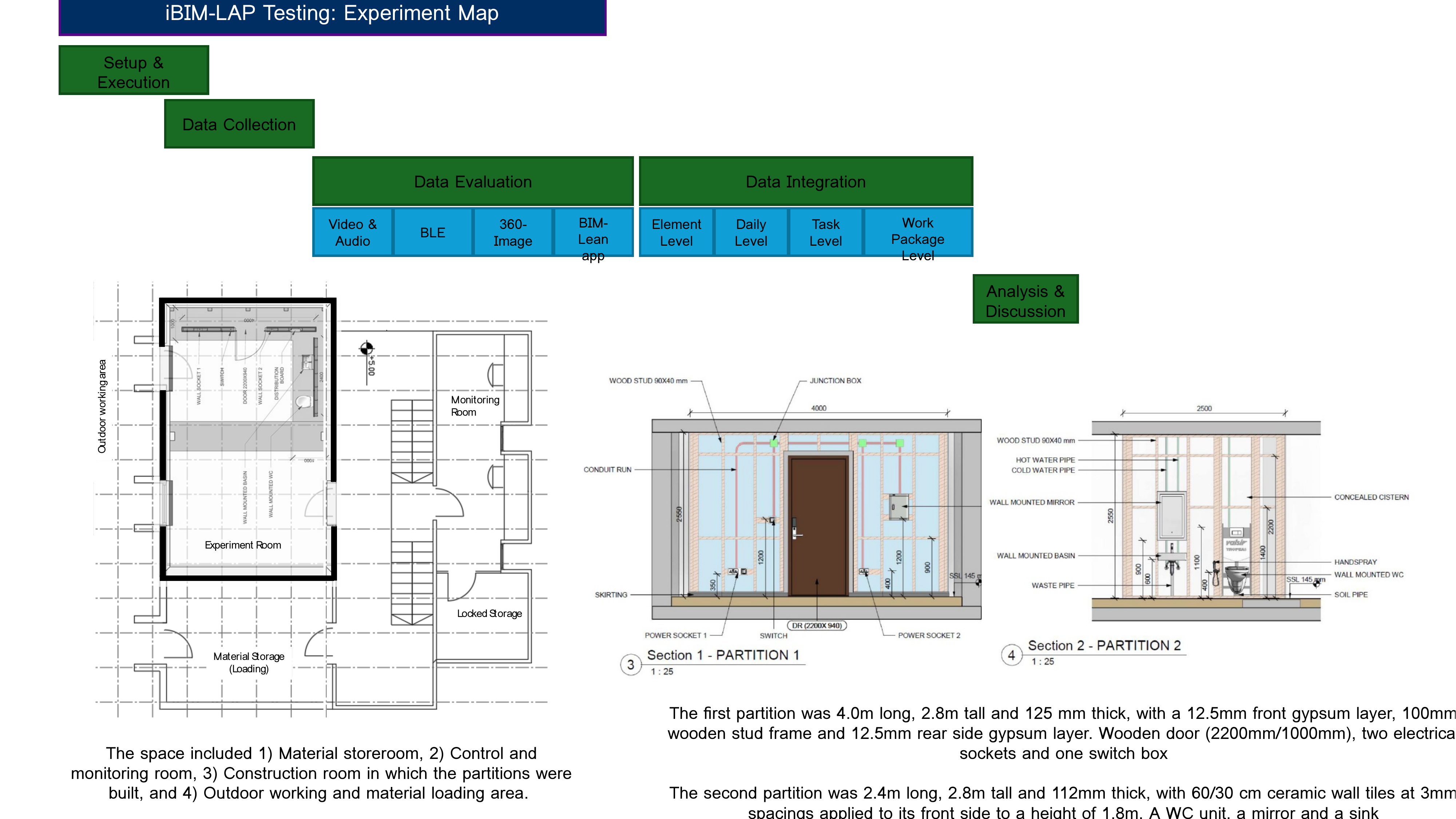
Experiment workflow: Setup & Execution → Data Collection → Data Evaluation → Data Integration → Analysis & Discussion.
iBIM-LAP Site Testing
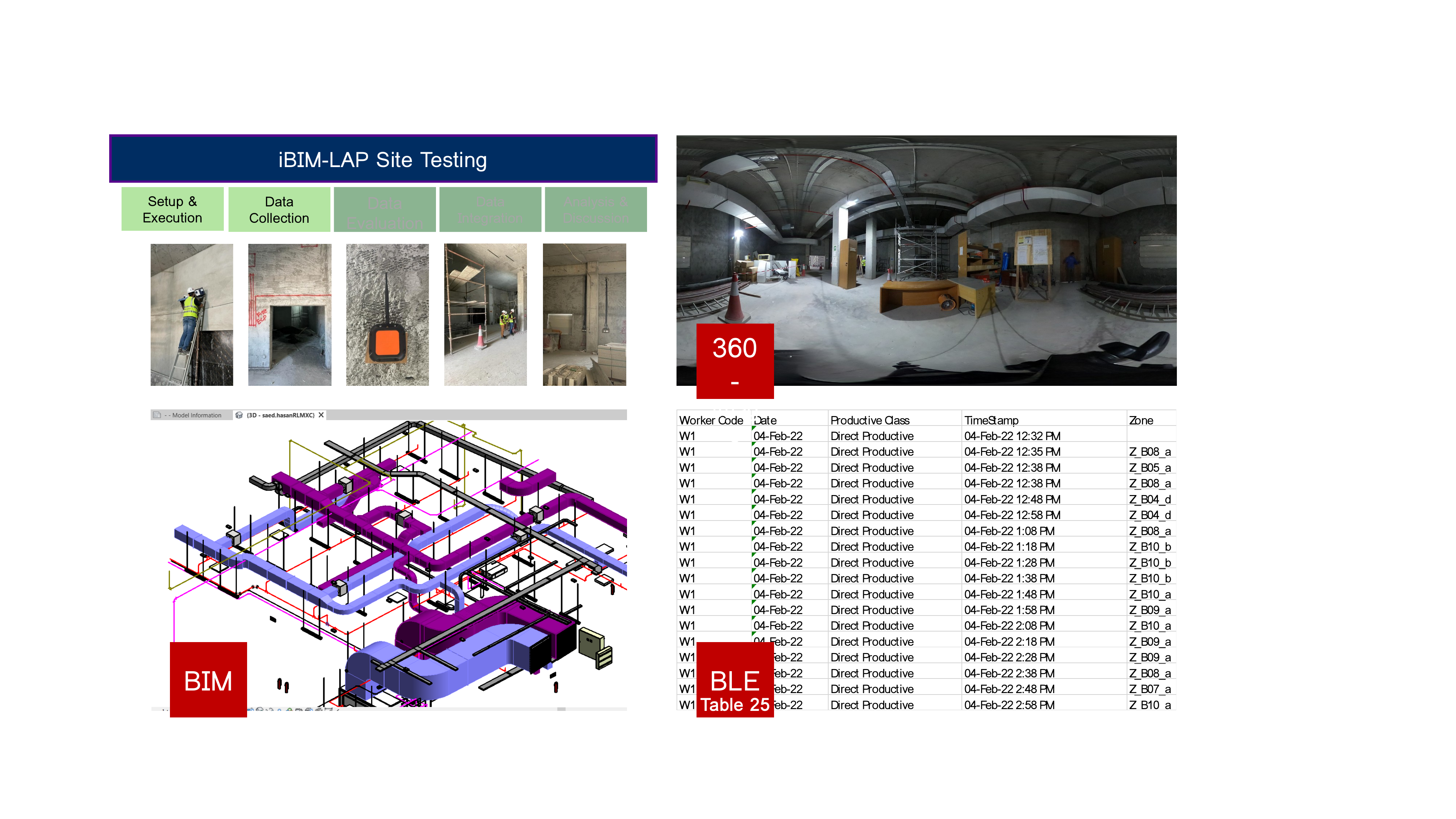
Site testing data collection using BIM models, 360° imaging, and BLE tracking technology.
Data Evaluation Methods
Video & Audio
BLE
360-Image
BIM-Lean app
Data Integration Levels
Element Level
Daily Level
Task Level
Work Package Level
Laboratory Setup
The space included 1) Material storeroom, 2) Control and monitoring room, 3) Construction room in which the partitions were built, and 4) Outdoor working and material loading area.
Partition 1
4.0m long, 2.8m tall, 125mm thick. 12.5mm front gypsum layer, 100mm wooden stud frame, 12.5mm rear gypsum layer. Wooden door (2200mm/1000mm), two electrical sockets and one switch box.
Partition 2
2.4m long, 2.8m tall, 112mm thick. 60/30 cm ceramic wall tiles at 3mm spacings applied to front side to height of 1.8m. WC unit, mirror, and sink.
Research Questions & Answers
Q1: How can multiple monitoring technologies be integrated to acquire comprehensive project status information?
Through an Event Processing Model (EPM) that applies multiple monitoring technologies in parallel and a set of algorithms to interpret data from multiple streams for operations control.
Q2: What information requirements are needed for real-time construction monitoring?
Product information (what was built), process information (when, by whom, for how long), and quality information (at what quality level) — all linked to BIM elements.
Q3: How can BIM be used as the central information hub for construction monitoring?
By establishing bi-directional data flows between BIM models and site monitoring systems, enabling automated progress tracking and deviation analysis.
Q4: What are the practical benefits of integrating multiple monitoring technologies?
Combining technologies produces more reliable project-status information than using each in isolation, supporting digital twin evolution with richer real-world to model feedback loops.